Saturday, May 12, 2012

Delhi belly, number five.

Catering to the masses.
Oh, those infamous Golden Arches.

More of a novelty than anything, I was curious to see how the I'm lovin' it-marketing team had developed their products to this nation of strict diet-following Indian consumers. Lo and behold, the menu was mainly comprised of chicken, potato and paneer (a type of fried cheese) as the staples.

Suprisingly not found on the menu, I was really hoping to try my luck at a mutton burger. What didn't surprise me however was that these Golden Arches are somewhat scarcely found in this country (this was only my second viewing after almost 2 weeks of travelling). But considering that there are other way more delicious options out there in the food department, why bother getting an overpriced aloo tikki (a nicely spiced potato cutlet) if the only difference is a 'Mc' prefix on some fancy packaging?


The McAloo Tikki burger.

 The Maharaja Mac.

Somebody should get a hurt real bad.

Friday, May 11, 2012

diplomatic delhi.

It's a shame that the day after I left India was to be Republic Day (not to be confused with their Independance Day in August), marking the day India officially adopted its constitution. It would have been nice to see all of the celebrations that the capital had prepared, including a grand parade that showcases India's Air Force, Army and Navy. 

Delhi's India Gate.

Politically, Delhi has been the gateway to so many important events... including the rise and fall of one great man, Gandhi.

Affectionately dubbed the 'Father of the Nation', his simplistic lifestyle, and minimal dress goes to show that it's not the clothes you wear that make who you are. Outraged that the British were milling local Indian cotton into cloth, then re-selling it back to the Indians, Gandhi promoted the movement of wearing a simple khadi, spun by hand himself from a simple charkha (similar to the one seen on the flag of India). Khadi wasn't therefore just simply a cloth, but a symbol that boycotted foreign-goods and also one that represented self-sufficiency, an important roadblock to India's path to independence.

Not only did he sacrifice basic necessities such as clothing and food, but his own freedom as his fight for equitable rights had him incarcerated on several occasions. His life's mission was to better the lives of everyone, especially those of India's lowest classes. His philosophy will always be an inspiration for peace and nonviolence - something that these days, the world needs a little more of.

The Rajghat, the site
of Gandhi's cremation.

Saffron for courage & sacrifice. 
White for truth & peace.
Green for faith & chivalry.

His life was his message.

Thursday, May 10, 2012

Delhi belly, number four.

I have to admit when I was a kid, I used to call it Goofy, thinking it was for some strange reason named after a beloved Disney character. But little did I know, it was only my young untrained ears that were picking up my parents' Indian pronounciation of the word, taking the "k" sound and turning into a soft "g".

Kulfi is to India,
as gelato is to Italy.

A cool icy treat, it usually comes in popsicle-form on a stick, but occassionally you'll find it in bowl-form as well. Although the flavours are endless, I would recommend the traditional pistachio or mango flavours for any first-timer. It also comes in the original malai kulfi, malai meaning cream, but it's not as exciting once you've had the others. 


I know this is the real deal, but I still
think J's mom makes it way better.

Wednesday, May 9, 2012

(not so) average agra.

If you go to India, the must-see is the Taj Mahal... or so they say.


What many visitors overlook is Agra's Red Fort, the grandiose fortress of red sandstone that once imprisonned Shah Jehan, the man who commissioned the construction of the Taj Mahal, in memory of his beloved wife, Mumtaz Mahal.


The story goes that Mumtaz died during childbirth in 1631, leaving Shah Jehan so heart-broken his hair turned grey virtually overnight. Completely grief-striken, he wanted to preserve her memory in what can be only worthy of the love of his life. Made with materials from all over Asia, it took more than 20 years to complete.

There is a myth that Shah Jehan wanted to create a black replica, across the river for his own tomb. But a little after the Taj Mahal was completed, his son, Aurangzeb, overthrew his father and put him under house arrest in the Agra Fort. The Shah Burj ironically had the most magnificent view of his loving wife's final resting spot. For years he sat, but only through a window, gazing at his immaculate creation.
Talk about a bittersweet ending, no?


The Muthamman Burj or Shah Burj.

Chillin' like villains,
on the Taj Mahal.

Spotted: an Indian-born Chinese
shutterbug.

Monday, April 30, 2012

hankering for henna.

A henna tree.
Being the last day in Rajasthan, it was also my last chance at henna. Normally the environment needed for farming good quality henna is hot and dry, perfectly found in Rajasthan since it's western edge is just desert land. I had seen the shop signs offering mehndi all throughout the state, and sure enough, our guide informed us that you will not find it anywhere else. After the application, I had to wait at least an hour before I could wash off the crusty dye. The mehndi expert assured me that if I stayed away from housework, it would last about two weeks. Unfortunately, despite how much I avoided cleaning floors and doing dishes, my once beautiful mehndi-ed hand turned into this sickly, faded orange colour in just a couple of days. Here's hoping that R's bridal mehndi party has longer-lasting results...


Peacock, the national bird of India.

Spotted.

Back.

Front.

Sunday, April 29, 2012

jai ho-ing in jaipur.

 
Up the hill to Amber Fort.

One-way elephant ride: 900 rupees.

Sharing a Kodak moment with your dad
 on an elephant: priceless.

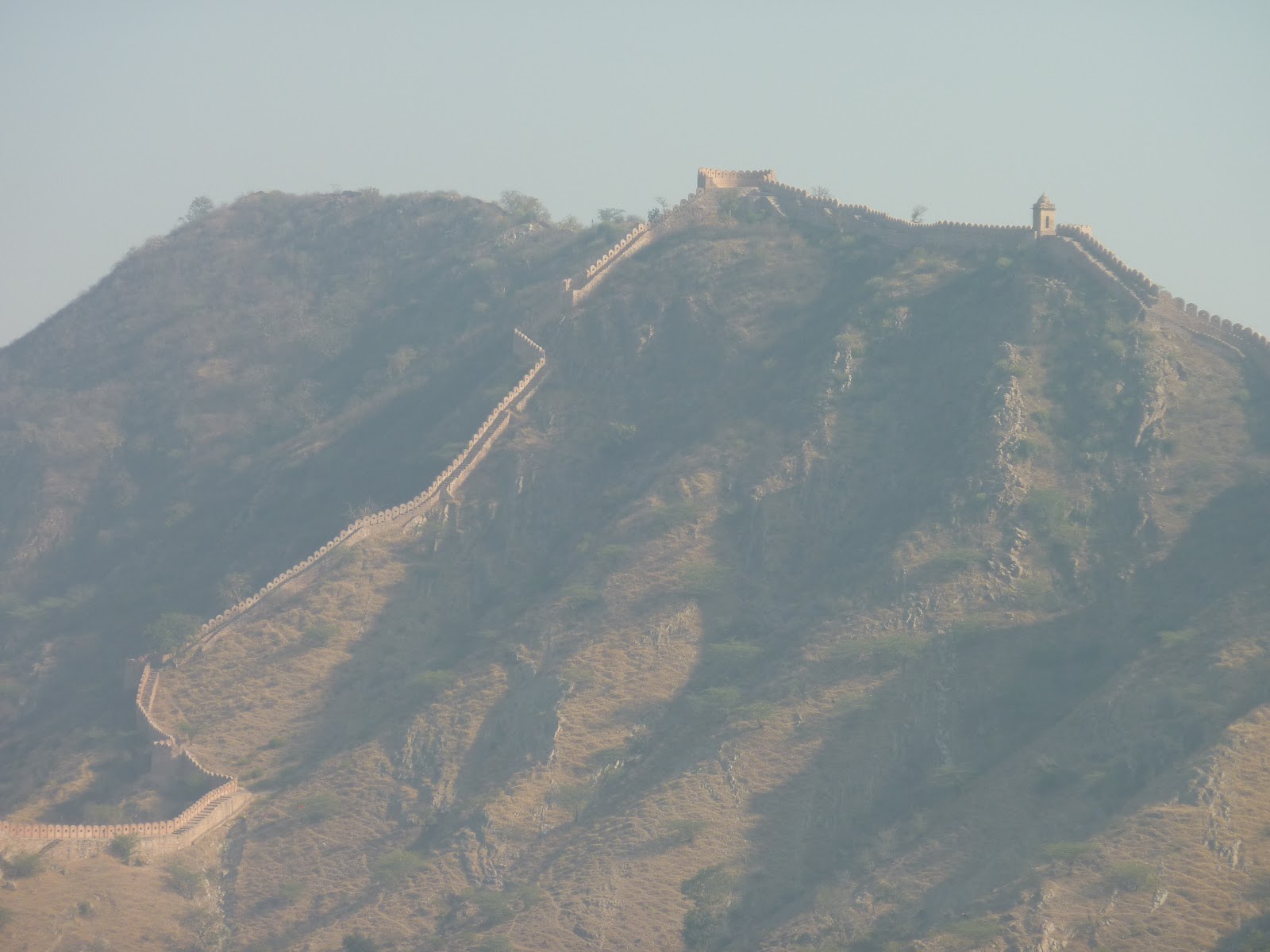
The Great Wall's Indian cousin.

Saturday, April 28, 2012

Delhi belly, number three.

When it comes to certain ethnic food, like everyone else I usually have a go-to staple. If it were Korean, I'd get kimbap. If it were Italian, I'd get insalata caprese. But my Indian one wasn't to be found in northern Rajasthan, but only in the southern parts of India. So you can imagine my joy when I discovered our lovely breakfast buffet had a dosa station, right across from the omelette one.  

The Indian version of a crèpe
made of lentils and rice, fermented
so a bit on the sour side.

Wrapped with different fillings, 
in this case sambar (a vegetable stew). 

Paired with a variety of chutneys,
the combinations are endless, miam!

Friday, April 27, 2012

jumping through jodhpur.

The first of what was to become a slew of Rajasthani forts, the Mehrangarh Fort hands down, had what I thought was the best hilltop view. Originally, the only buildings painted blue were those of the "Brahmin" caste, meaning priests or those with the highest spiritual knowledge, who wanted to be set apart from the other castes. In the end, the  calming blue colour was adopted by the others since it cooled the buildings interiors and kept away mosquitoes. If the view isn't enough for you, the ziplining will definitely immortalize the experience. I'm sure the film crew of Dark Knight Rises will agree with me.

The majestic Mehrangarh Fort.

The Dark Knight Rises
at Mehrangarh Fort.

The Blue City.

If you're ever in the area,
do check out Flying Fox Jodhpur.